Forming Clay on the Wheel
Wheel throwing looks fluid in a finished demonstration, but it is a sequence of distinct, learnable actions. A spinning wheel head provides rotational symmetry; the potter's hands provide pressure and a fixed reference point. Where those two meet, soft clay takes a controlled shape. The difficulty is that clay resists in three directions at once, and small inconsistencies multiply with each rotation.
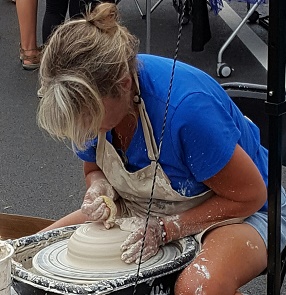
The sequence of throwing
Although styles differ, almost every thrown form passes through the same ordered steps. Each one depends on the previous being done well.
- WedgingWorking the clay before it touches the wheel removes air pockets and aligns the particles so the body behaves consistently.
- CenteringPressing the rotating clay until it runs true. Until the mass is centered, every later step fights an off-balance form.
- OpeningPressing down into the centered mass to create the interior floor, setting the base thickness.
- Pulling the wallsCompressing clay between inside and outside hands and lifting it upward, thinning and raising the wall in stages.
- Shaping and trimmingRefining the profile, then later trimming the leather-hard piece to define the foot.
Why thrown pots collapse
Beginners rarely fail at the dramatic moment; the failure is usually set up earlier. A few recurring causes account for most collapses.
- Too much water. Water reduces friction so the hands can move, but excess water weakens the wall and the clay slumps. Slip building up inside a tall form is a frequent culprit.
- Uneven walls. A thin section high on the wall cannot support the clay above it. Pulling in even passes keeps thickness consistent.
- Lost centering. A wobble introduced during opening is amplified with every pull, throwing the rim out of true.
Compression matters as much as height. Pressing the floor and rim firmly during forming reduces the cracks that otherwise appear during drying and firing, when stresses concentrate at weak boundaries.
Hand building as an alternative
The wheel is not the only route. Pinch pots, coil building, and slab construction form clay without rotation and remain the basis of a great deal of historical and contemporary ceramic work. These methods give more direct control over asymmetric forms and are often where studios in community settings begin, since they need less equipment than a powered wheel.
Whichever method is used, the goal of the forming stage is the same: an even-walled, well-compressed piece that can survive the slower, less forgiving stages of drying and firing that follow. For those, see Drying Ceramic Pieces and Firing and Kilns.