
Forming
Forming Clay on the Wheel
Centering, opening, and pulling walls — the mechanics behind a thrown pot and the common reasons walls collapse.
Read the article →Morximel collects the core steps behind handmade pottery, from centering wet clay to the chemistry of a kiln firing. The writing favours clear technique over jargon, with notes for studios working in Canadian conditions.
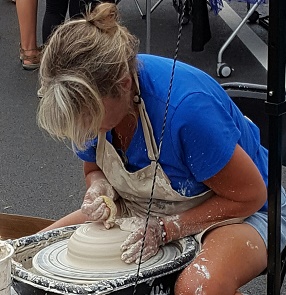
Throwing on the wheel. Photo: Wikimedia Commons, CC.
Most ceramic work moves through the same sequence regardless of style: a piece is formed while the clay is plastic, dried slowly until it is stable, then fired to convert the clay body into hardened ceramic. Each stage has its own failure points and its own habits worth learning.
Centering, opening, and pulling walls — the mechanics behind a thrown pot and the common reasons walls collapse.
Read the article →
Why uneven drying cracks pots, what leather-hard means in practice, and how humidity affects timing.
Read the article →
Bisque versus glaze firing, what happens to clay at temperature, and why firing schedules are gradual.
Read the article →Clay is a fine-grained earthen material that becomes plastic when mixed with water and rigid when fired. That plasticity is what lets a maker pull a flat lump into a tall wall; the firing is what makes the change permanent. Understanding both states explains nearly every technique that follows.
Studio clay bodies are usually grouped by the temperature they mature at. Earthenware matures at lower temperatures and stays comparatively porous; stoneware and porcelain mature higher and become dense and durable. The choice of body shapes drying behaviour, glaze fit, and how a piece is fired.
| Body | Character after firing |
|---|---|
| Earthenware | Lower-temperature, more porous, often glazed for liquids |
| Stoneware | Higher-temperature, dense, hard-wearing |
| Porcelain | High-temperature, fine and translucent when thin |
Exact maturing temperatures vary by manufacturer; always check the clay body's data sheet.
Morximel is an educational reference. If you spot an inaccuracy or want to suggest a topic, send a note using the form. This form runs in your browser for demonstration and does not transmit data to a server.
General enquiries
editor@morximel.org
Coverage
Written for studio potters and beginners, with Canadian studio context where relevant.